
Burlington Previous Residents by Era
A useful address history changes source as it moves backward. The present parcel links to the tax and deed layers. Early twentieth-century households are often better seen in local directories and newspapers. Older ownership and estate questions can require the Register of Deeds counter or the State Archives. The table separates what has been located from what has not. It avoids turning a visible online sample into a promise of complete electronic coverage.
| Source | Years it covers | Where held | What it can show |
|---|---|---|---|
| Cott land-record index | Online start not officially located; visible map/plat sample spans 1980 to 2026 | Register of Deeds portal and counter | Recorded parties, deeds, plats, book/page, legal description, images where available |
| Commercial Service directories | 1909–10, 1920–21, 1924–25, 1927–28, 1929–30 located | DigitalNC and UNC collection | Household or business name, address, street section, and local context |
| Hill Burlington directories | 1935, 1937, 1939, 1941, 1943, 1948, 1954, 1962 located | DigitalNC and Alamance County Public Libraries | Occupant, spouse, occupation, employer, house or roomer notation, address |
| Federal census | 1790–1950 schedules | Census access and library databases | Household composition and approximate address context |
| Sanborn map | 1929, republished 1952, 39 sheets | Library of Congress | Building footprint, use, and street-block setting |
| Alamance estate series | 1856–1949 | North Carolina State Archives | Probate, heirs, and other endpoints in an ownership trail |
Building permits are another dating clue. County records have current and legacy material, though an exact start year was not located. A permit can identify an applicant or contractor and an inspection date. It does not prove that person owned or lived at the property.
Start Burlington Previous Residents With a Parcel
Begin with Alamance Tax and the Alamance GIS interactive map. Record the current owner, parcel or real-property identifier, situs address, legal description, acreage or lot information, and book/page reference when displayed. A situs address is the parcel location. A mailing address is where a tax bill goes, which may be elsewhere. That distinction keeps a tax contact address from being mistaken for a former resident.
The county’s property vocabulary includes book and page, qualification code, date, sales price, notes, and percent complete. Exact live card labels, exemption controls, and history depth were not verified during the research. Treat them as fields to inspect, not fields every card is guaranteed to show. The parcel’s legal description is often the stronger bridge when a street number or street spelling changed.
Preserve the identifiers. Write down the parcel ID, legal description, book/page, and both address forms before going backward. A street number alone can change while the legal land description remains stable.
Burlington Previous Residents in Cott
The Alamance County Cott Land Records search is the recorded-document layer. Search by grantor or grantee, directory, document type, or book/page, then compare date filed, party names, description, file number, book/page, amount, and any image. The office advises using Directory rather than All Matches after its formatting changes. Cott’s accessible sample shows map/plat material dated from 1980 through 2026, but the official public sources do not state the online index’s beginning year.
The Register of Deeds Cott map/plat result is the recorded-document example captured for Burlington address-history work.
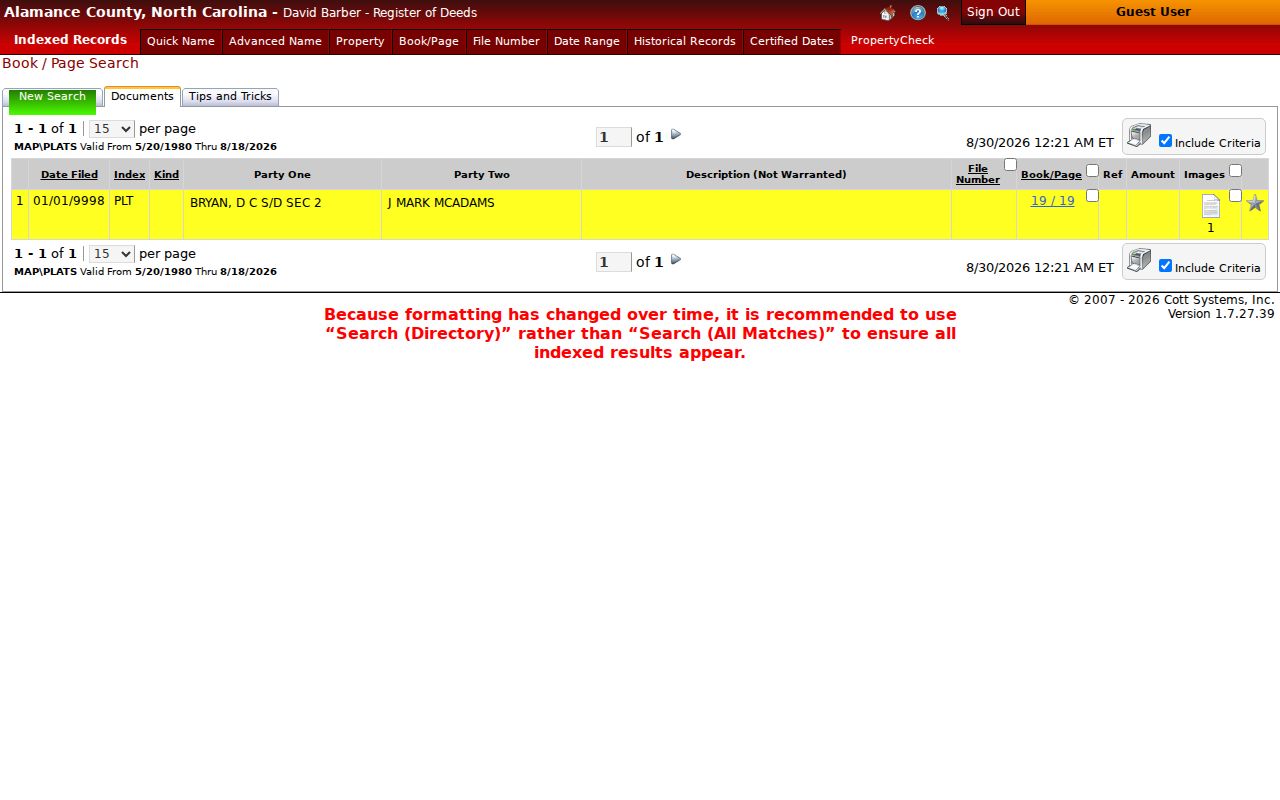
A book/page reference can lead to an older instrument even when the modern street address does not. The visible sample is a document example, not evidence that online records start in 1980.
Trace Burlington Previous Residents Through Deeds
A chain of title is the succession of recorded transfers for the same land. It is an ownership trail, not a complete list of everyone who lived in the building. The local method documented by Preservation Alamance’s house-history guide begins with the current parcel, then moves from the last seller to that seller’s earlier purchase. Each connection should be checked against the legal description, lot or block, subdivision, acreage, and nearby ownership.
- Open the current tax record and copy its book/page reference and legal description.
- Find the current owner’s purchase deed in Cott and identify the seller, also called the grantor.
- Search that seller as a grantee, the buyer on an earlier deed, to find the prior purchase.
- Follow the cited book/page and compare the land description before accepting the next link.
- Repeat backward. When the online trail stops, ask the Register of Deeds about deed books, microfilm, and older index drawers.
- Grantor and grantee
- The grantor transfers an interest in land. The grantee receives it. The labels change direction as the chain moves backward.
- Chain of title
- A sequence of recorded conveyances for the same parcel or legal description.
- Legal description
- The lot, block, subdivision, metes-and-bounds, or other land description in a deed. It is usually more durable than a street number.
When Burlington Previous Residents Leave the Web
Older material is not a dead end. The Register of Deeds in Graham is the immediate fallback for deed books and older indexes. The Alamance County Register of Deeds is the official office route, while the Alamance County estate collection and other county series at the State Archives can add probate or historical-transfer context. The research found estates for 1856–1949 and a miscellaneous series for 1836–1939, not a complete online estate or deed index.
North Carolina’s Public Records Act allows inspection at reasonable times and permits a custodian to charge actual copying costs or special service charges for extensive work. It does not require staff to create a new address history. Ask for a specific volume, book/page, instrument, or existing index. If an office route fails, use the counter, the local-history room, or the State Archives search room rather than assuming the record does not exist.
Newspapers and library collections provide a parallel fallback for people rather than title. May Memorial’s Community History Archive and obituary abstracts can be searched by a person, spouse, street, school, church, or approximate year. The research identifies Times-News holdings for 1954–57, 1978–88, and 1990–2025, as well as historical pages through 1970, but also notes gaps. Ask the library whether a needed issue is scanned, in the archive, or on microfilm. A notice can connect a former address to relatives, a cemetery, or a later town without proving continued residence.
Note: An online gap is a reason to change access channels, not proof that a Burlington transfer or household never existed.
Burlington Past Residents in Directories
Deeds identify recorded parties, but old street sections and census schedules can reveal the household layer. The May Memorial local-history resources connect Burlington directories, obituary abstracts, newspapers, maps, yearbooks, and library databases. DigitalNC’s scanned runs are discontinuous. A blank year may reflect a missing volume or a publication gap, not a vacant house. The historical volumes themselves are examined in depth on the Burlington city directory page.
- Locate the street in the closest available directory volume and transcribe the full entry, including house or roomer notation.
- Compare the next located directory, not just the next calendar year, for a name, spouse, and address change.
- Pair the directory date with the nearest available census schedule for household composition and age context.
- Use DigitalNC’s city-directory collection, May Memorial, and microfilm when the scan or year is missing.
Obituary abstracts, city cemetery records, and estate indexes can close a trail after a household leaves the street. They may identify relatives, a later town, a death date, or an estate filing. An omission alone is not enough to infer why someone moved.
Burlington Previous Residents and Sanborn Sheets
The Library of Congress Burlington Sanborn set dates to 1929 and was republished in 1952. Its 39 sheets can place a building on a block when a directory gives only a street. The maps show building footprints, use, and street context. They do not name the residents. Pair a sheet with a dated directory entry, deed description, or census record instead of treating a mapped building as a household record.
Burlington’s earlier name also matters. The railroad community was known as Company Shops, was incorporated in 1866, became Burlington in February 1887, and was incorporated as a city in 1893. Historic directories may use an older place name, a mill-village reference, or a street form that does not map cleanly to today’s label. No authoritative citywide street-renumbering schedule was located.
Early street lists include names and neighborhood forms such as Court House Square, East End, West Burlington, Petersburgh, Piedmont Way, Plaid, Sugar Hill, and Richmond Hill. They are search variants, not automatic modern-address matches. Preserve the spelling used by the historical source, then compare it with the map and deed evidence before joining it to a current parcel.
Note: Compare cross streets, nearby names, plats, and the Sanborn layout before deciding that an old Burlington address matches a current house number.
Respecting Burlington Previous Residents
Address history supports family research, estate and heir questions, preservation work, and personal curiosity. It does not make every current occupant public. A tax owner may use another mailing address. A deed party may be a trustee, estate representative, lender, or former owner. A directory can record one householder while omitting others. Protected addresses, restricted court material, and confidential vital information remain outside a normal address trail.
Lawful use. Use Burlington past-resident records for legitimate personal and historical research. Do not use an address trail to stalk, harass, intimidate, or harm any living person.
When a source needs correction, contact the source custodian: Tax or GIS for a parcel record, the Register of Deeds for a recorded document, Elections for voter data, and the library or DigitalNC for a scanned publication’s metadata. A lawful historical record may still remain part of its original collection.